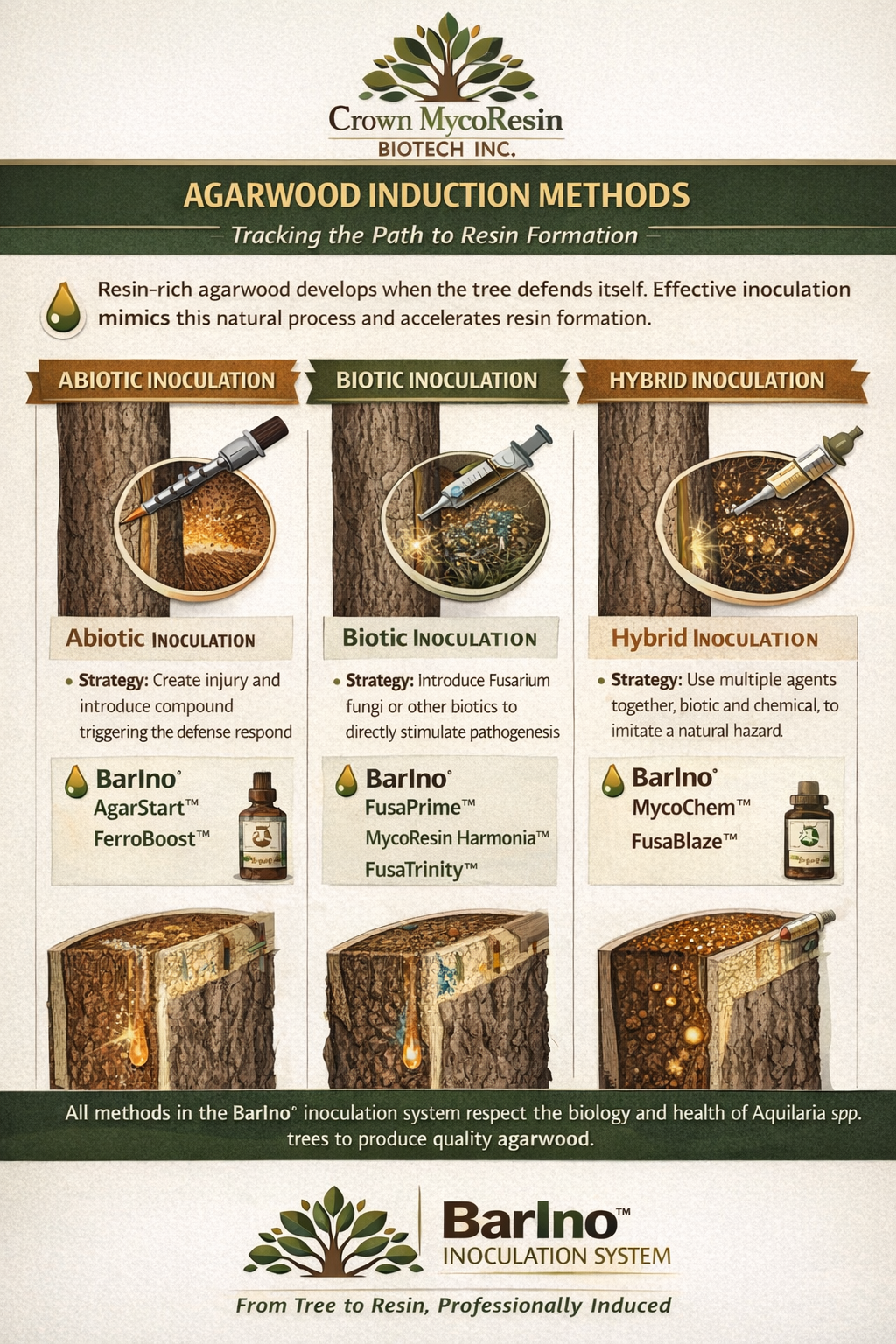
Agarwood induction refers to the intentional stimulation of resin formation in species such as Aquilaria malaccensis and other Aquilaria trees. In nature, agarwood forms when the tree experiences injury or infection, triggering a defense response that produces the fragrant resin known as Oud.
1. Natural Induction (Wild Formation)
- Process: Resin forms naturally when trees are injured by storms, insects, or microbes.
- Time: 10–30+ years.
- Resin Quality: Often the highest grade.
- Yield: Extremely rare (only about 1–2% of wild trees produce agarwood).
Advantages
- Premium quality oud.
- No artificial intervention.
Disadvantages
- Unpredictable.
- Very low production rate.
2. Mechanical Induction Method
How it works:
Physical wounds are created in the tree to stimulate resin production.
Techniques
- Drilling holes into the trunk
- Cutting or chiseling bark
- Hammering nails or inserting bamboo sticks
Time to harvest: 2–6 years.
Advantages
- Low cost
- Simple to implement
Disadvantages
- Resin distribution is irregular.
- Lower oil yield compared with biological methods.
3. Chemical Induction Method (Modern Artificial Method)
This method uses chemical stimulants injected into the tree to mimic stress.
Common chemicals used
- Sodium chloride
- Ethanol
- Acetic acid
- Hydrogen peroxide
- Other proprietary formulations
Process
- Drill holes into the trunk.
- Inject chemical solution.
- Seal the hole.
Time to harvest: 1–3 years.
Advantages
- Faster resin formation.
- More predictable than mechanical injury.
Disadvantages
- Sometimes produces lower aroma complexity.
- Potential environmental concerns.
4. Biological / Microbial Induction Method
This method uses fungi or bacteria that naturally stimulate resin production.
A common fungus used in research is:
- Fusarium oxysporum
Process
- Drill holes in the trunk.
- Inject fungal culture or spore suspension.
- The fungus colonizes the wood.
- The tree produces resin as a defense response.
Time to harvest: 1.5–4 years.
Advantages
- Produces high-quality resin similar to natural agarwood.
- Environmentally friendly.
Disadvantages
- Requires microbiology expertise.
- Resin formation can be inconsistent.
(Your work with Fusarium-based inoculants like BarIno™ systems fits in this category.)
5. Enzymatic / Biochemical Induction
Instead of whole microorganisms, enzymes or metabolic compounds are used.
Examples
- Cellulases
- Laccases
- Fungal metabolites
Advantages
- Controlled biochemical stimulation.
- Reduced risk of uncontrolled infection.
Disadvantages
- Expensive technology.
- Still under research in many regions.
6. Dual Induction System (Hybrid Method)
This method combines biotic and abiotic induction.
Example approach
- Chemical stimulation + fungal inoculation
or - Mechanical wounding + microbial consortium
Advantages
- Faster resin formation.
- Higher resin density.
- Better aroma profile.
Typical commercial protocols
- Sequential inoculation systems
- Multi-phase induction technologies
(Systems like BarIno™ Sequential Induction Protocol belong to this category.)
7. Advanced Biotechnology Induction
Emerging technologies include:
- Tissue Culture & Organogenesis
- Propagation of elite trees using plant biotechnology.
- Microbial Consortium Engineering
- Multiple fungi/bacteria designed to enhance resin pathways.
- Metabolic Pathway Activation
- Stimulating genes responsible for sesquiterpene production.
These research areas relate to work done in agarwood biotechnology institutes and organizations like the Agarwood Growers Association of the Philippines Inc..
Comparative Overview
| Method | Speed | Resin Quality | Cost | Predictability |
|---|---|---|---|---|
| Natural | Very Slow | Very High | Low | Very Low |
| Mechanical | Slow | Medium | Very Low | Low |
| Chemical | Fast | Medium | Medium | Medium |
| Biological | Medium | High | Medium | Medium |
| Dual Induction | Fast | High | Medium–High | High |
| Biotechnology | Variable | Very High | High | High |
Current Industry Trend:
The global agarwood industry is moving toward biological and dual-induction biotechnology systems, because they balance quality, sustainability, and predictable yield.