An agarwood inoculant developed abroad might perform poorly in the Philippines because an inoculant is not operating in isolation. Its effectiveness depends on the interaction among the microbial agent, Aquilaria host, climate, soil, native microbiome, and application method.
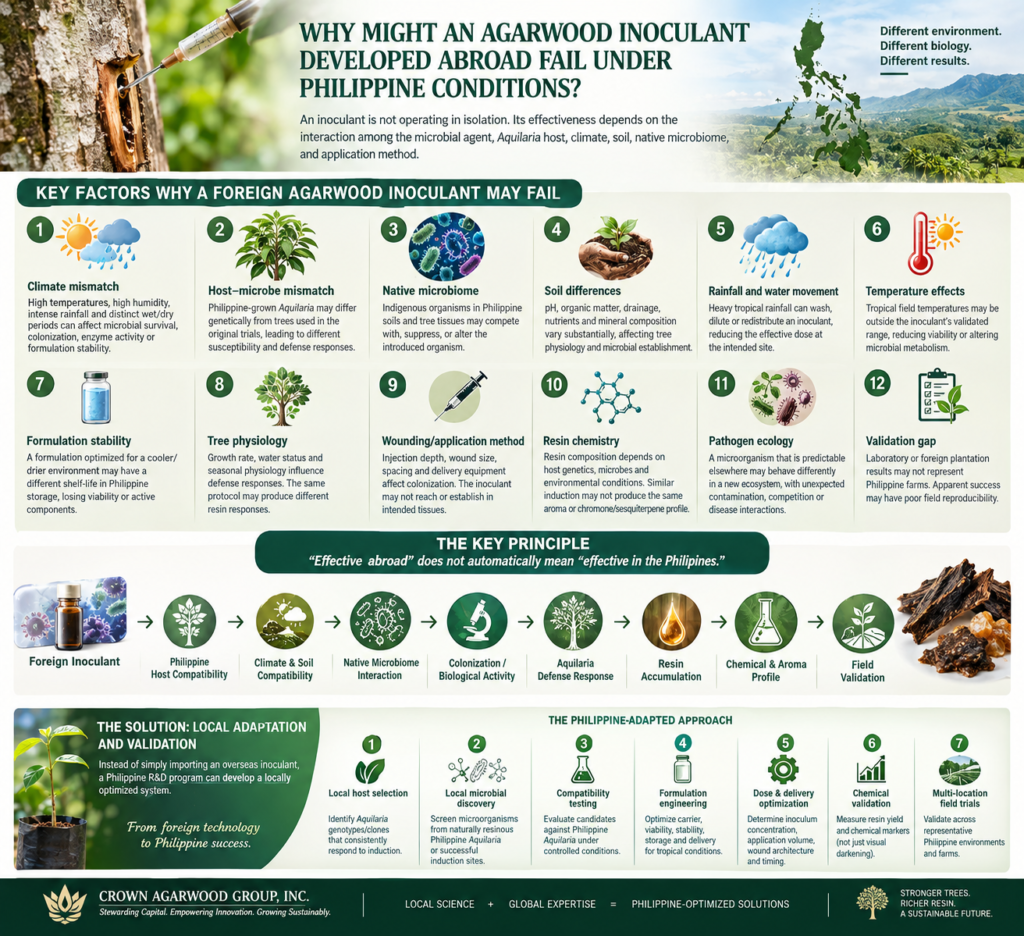
Why a foreign agarwood inoculant may fail in the Philippines
| Factor | Philippine condition | Possible consequence |
|---|---|---|
| 1. Climate mismatch | High temperatures, high humidity, intense rainfall and distinct wet/dry periods | Microbial survival, colonization, enzyme activity, or formulation stability may differ |
| 2. Host–microbe mismatch | Philippine-grown Aquilaria may differ genetically from trees used in the original trials | Different susceptibility and defense responses can produce different resin formation |
| 3. Native microbiome | Philippine soils and tree tissues contain their own bacterial and fungal communities | Indigenous organisms may compete with, suppress, or alter the introduced organism |
| 4. Soil differences | pH, organic matter, drainage, nutrients and mineral composition vary substantially | Tree physiology and microbial establishment may change |
| 5. Rainfall and water movement | Heavy tropical rainfall can wash, dilute or redistribute an inoculant | Lower effective dose at the intended wound/site |
| 6. Temperature effects | Tropical field temperatures may be outside the inoculant’s validated range | Reduced viability or altered microbial metabolism |
| 7. Formulation stability | A formulation optimized for a cooler/drier environment may have different shelf-life in Philippine storage | Loss of viable organisms or active components |
| 8. Tree physiology | Growth rate, water status and seasonal physiology influence defense responses | Same inoculation protocol may produce different resin responses |
| 9. Wounding/application method | Injection depth, wound size, spacing and delivery equipment affect colonization | Inoculant may not reach or establish in the intended tissues |
| 10. Resin chemistry | Resin composition depends on host genetics, microbes and environmental conditions | Similar induction may not produce the same aroma or chromone/sesquiterpene profile |
| 11. Pathogen ecology | A microorganism that is relatively predictable elsewhere may behave differently in a new ecosystem | Unexpected contamination, competition or disease interactions |
| 12. Validation gap | Laboratory or foreign plantation results may not represent Philippine farms | Apparently successful technology may have poor field reproducibility |
The key principle
“Effective abroad” does not automatically mean “effective in the Philippines.”
A foreign inoculant essentially has to pass a local adaptation and validation process:
Foreign Inoculant
↓
Philippine Host Compatibility
↓
Climate & Soil Compatibility
↓
Native Microbiome Interaction
↓
Colonization / Biological Activity
↓
Aquilaria Defense Response
↓
Resin Accumulation
↓
Chemical & Aroma Profile
↓
Field Validation
This is particularly important for a Philippine agarwood biotechnology platform
Rather than simply importing an overseas inoculant, a Philippine R&D program could investigate:
1. Local host selection
Identify Aquilaria genotypes/clones that consistently respond to induction.
2. Local microbial discovery
Screen microorganisms associated with naturally resinous Philippine Aquilaria or successful induction sites.
3. Compatibility testing
Evaluate candidate microorganisms against representative Philippine Aquilaria material under controlled conditions.
4. Formulation engineering
Optimize carrier, viability, stability, storage and delivery for tropical conditions.
5. Dose and delivery optimization
Determine appropriate inoculum concentration, application volume, wound architecture and timing through controlled trials.
6. Chemical validation
Measure resin yield and chemical markers rather than relying only on visual darkening.
7. Multi-location field trials
Validate across representative Philippine environments rather than at a single plantation.
This provides a strong scientific rationale for a Philippine-adapted MycoResin™ / BarIno® platform: the objective is not merely to import a microorganism, but to develop an integrated host × microbe × environment × formulation × application system optimized for Philippine Aquilaria.
In short: the competitive advantage is potentially not the foreign microorganism itself, but the local biological intelligence and validation system surrounding it.
