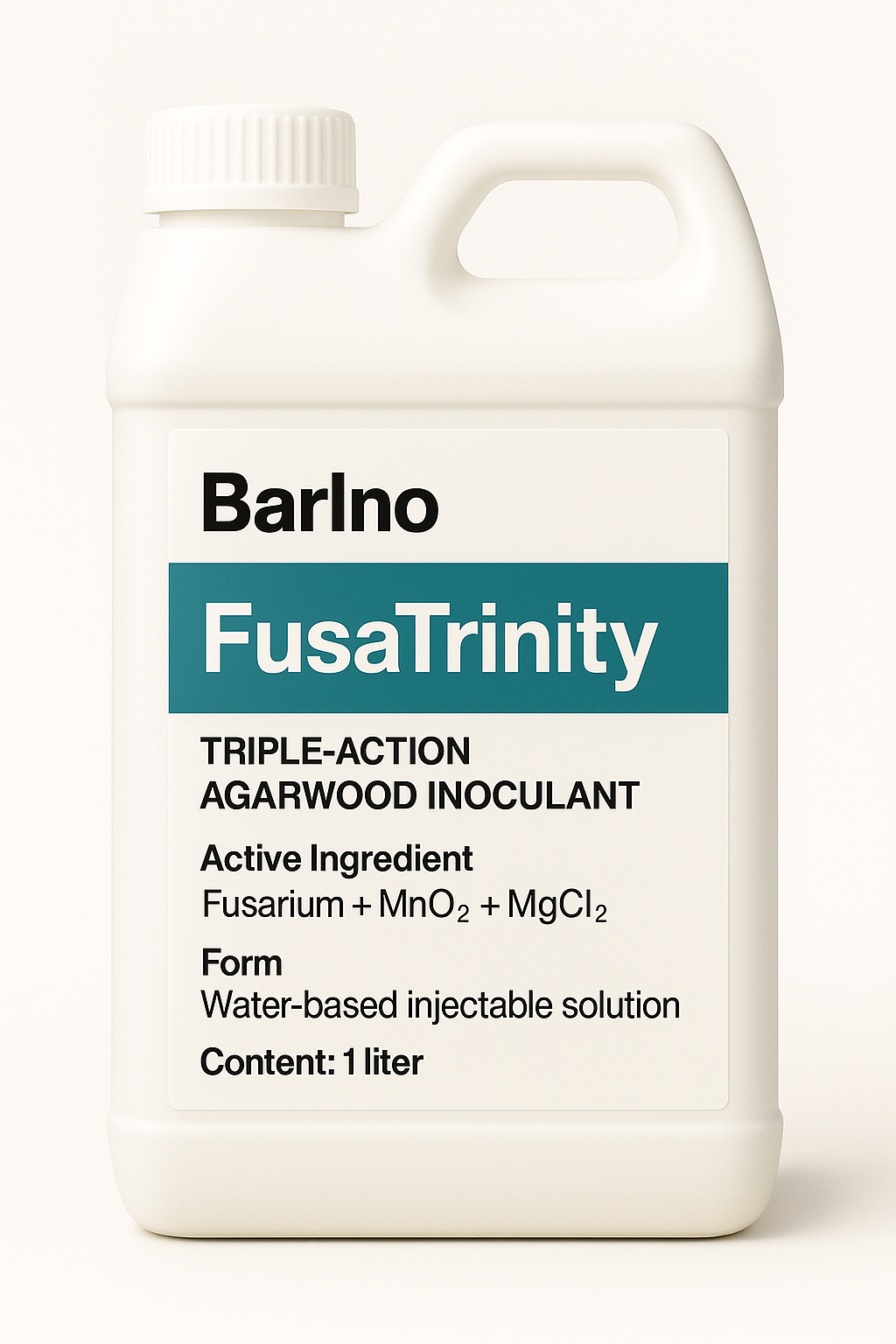
Description
Field Application Guide
1. Objective
Provide a step-by-step field procedure for effective and safe induction of high-quality agarwood resin using BarIno™ FusaTrinity™, maximizing resin yield, tree health, and ROI.
2. Tree Selection
| Parameter | Requirement |
|---|---|
| Species | Aquilaria malaccensis, A. crassna, other commercial species |
| Age | ≥ 5–7 years |
| DBH | ≥ 10 cm |
| Health | Disease-free, actively growing |
| Soil | Well-drained, fertile, no waterlogging |
Tip: Avoid trees with severe mechanical damage or chronic disease.
3. Materials & Equipment
- BarIno™ FusaTrinity™ inoculant
- Power drill (6–8 mm drill bit)
- Measuring tape / DBH tape
- Syringe or injector (5–20 mL)
- Marker or chalk for hole layout
- PPE: gloves, mask, goggles
- Rubber plugs or dowels (optional)
4. DBH Measurement & Hole Calculation
Measure Diameter at Breast Height (1.3 m):
DBH (cm) = Circumference ÷ 3.14
Determine number of inoculation points:
| DBH (cm) | Holes | Total Inoculant Volume |
|---|---|---|
| 10–15 | 10–20 | 100–150 mL |
| 15–25 | 20–40 | 150–300 mL |
| 25+ | 40–80 | 300–600 mL |
Tip: Larger trees require more holes and careful spacing for uniform resin distribution.
5. Drilling Pattern Guidelines
A. Small Trees (10–15 cm DBH)
- Spiral Pattern
- Vertical spacing: 10–12 cm
- Hole depth: 5–6 cm
- Angle: 45° downward
B. Medium Trees (15–25 cm DBH)
- Double Spiral Pattern
- Vertical spacing: 10–15 cm
- Hole depth: 6–7 cm
C. Large Trees (25+ cm DBH)
- Vertical Grid Pattern
- Vertical: 10–15 cm | Horizontal: 5–10 cm
- Hole depth: 7–8 cm
- Visual Reference: Think of the trunk as a clock face—distribute holes evenly for uniform induction.
6. Inoculation Procedure
- Prepare inoculant: Shake BarIno™ FusaTrinity™ bottle gently to homogenize.
- Fill injector/syringe: 5–10 mL per hole (adjust for tree size).
- Inject inoculant into each hole: Ensure liquid fully penetrates.
- Optional: Plug holes with rubber/wood dowel to retain moisture.
- Note: Avoid overfilling to prevent leakage and surface contamination.
7. Post-Inoculation Tree Care
- Water moderately if soil is dry; avoid waterlogging.
- Maintain tree health and nutrient supply.
- Protect from mechanical damage or pests.
- Monitor for stress response, wood darkening, and initial resin formation.
8. Monitoring & Follow-Up
| Timeline | Observation |
|---|---|
| 1–2 months | Initial stress response, slight darkening around holes |
| 3–6 months | Resin formation visible, dark streaks inside wood |
| 6–12 months | Mature resin, ready for selective harvest |
- Tip: Document hole layout and tree response for sequential induction cycles.
9. Re-Inoculation / Sequential Protocol
- Optional second inoculation after 6–9 months
- Targets:
- Expanding resin zones
- Increasing yield and oil density
- Works best with BarIno™ sequential inoculation system for premium-grade output.
10. Safety Guidelines
- Wear gloves, mask, and eye protection.
- Avoid inhaling aerosols.
- Clean drill and injector after use.
- Store inoculant in cool, dark place (4–25°C).
11. Field Efficiency Metrics
| Metric | Benchmark |
|---|---|
| Trees treated per day (per 2-person team) | 50–150 |
| Holes drilled per hour | 200–400 |
| Inoculant use efficiency | ≥ 90% |
12. Key Notes for Investors / Farm Managers
- Predictable Yield: DBH-based drilling ensures uniform resin zones.
- Premium Output: Tri-modal induction maximizes chromone and sesquiterpene accumulation.
- Sustainable & Traceable: Minimizes tree mortality and chemical waste.
- Market Ready: Optimized for GCC, luxury perfumery, and high-end chip/oil markets.
Field Application Summary
- Measure DBH → Determine holes & inoculant volume.
- Drill holes (angle & spacing per DBH).
- Inject BarIno™ FusaTrinity™ into each hole.
- Optional: Plug holes to retain moisture.
- Monitor tree response and resin formation.
- Apply sequential treatments if needed.
- Maintain tree health & document results.