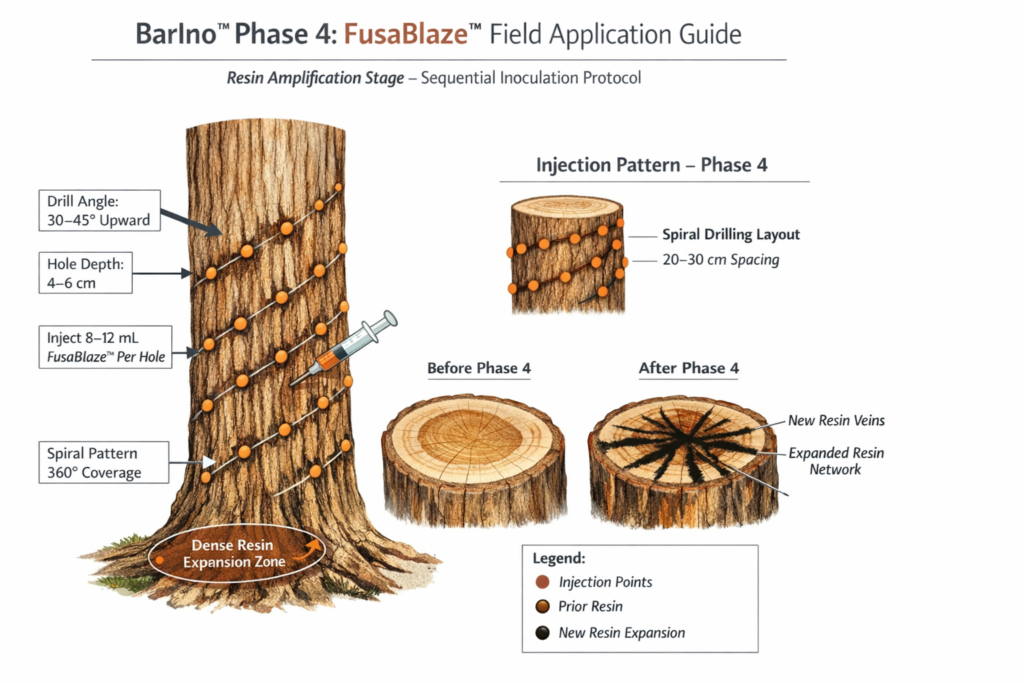
1. Phase 4 Objective
- Expand resin beyond Phase 3 zones
- Increase resin density and distribution
- Enhance sesquiterpene and chromone concentration
- Prepare tree for premium-grade production (Phase 5 or harvest)
2. Ideal Tree Condition (Pre-Application)
Apply only to trees that have completed Phase 3 (FusaTrinity™):
- Age: ≥4–6 years old
- DBH: ≥12–15 cm
- Visible resin: Present (dark streaks near earlier inoculation points)
- Tree health: Stable, not under severe stress
Do NOT apply if:
- Tree shows severe infection or decay
- No resin response from previous phases
- Tree is drought-stressed or waterlogged
3. Timing of Application
- Best Timing: 2–4 months after Phase 3
- Season: Dry to moderately humid conditions
- Avoid heavy rainfall periods (prevents dilution and contamination)
4. Drilling / Wounding Design (Phase 4 Pattern)
Enhanced Resin Expansion Layout
- Hole Diameter: 10–12 mm
- Depth: 4–6 cm (slightly deeper than Phase 3)
- Angle: 30–45° upward
- Spacing:
- Vertical: 20–30 cm (denser than previous phase)
- Spiral pattern around trunk for 360° resin coverage
Target Zones
- Expand beyond previous inoculation points
- Include:
- Upper trunk
- Secondary branches (if DBH allows)
5. Inoculant Preparation (FusaBlaze™)
- Dilution: 1:5 to 1:10 (slightly stronger than earlier phases if needed)
- Mixing: Gentle inversion only
- Temperature: Keep at 20–25°C before use
Phase 4 may use slightly higher enzyme concentration to enhance expansion
6. Injection Protocol
Per Injection Point:
- Volume: 8–12 mL per hole
- Ensure full absorption into xylem tissue
Procedure:
- Drill hole following Phase 4 pattern
- Inject FusaBlaze™ slowly
- Allow solution to penetrate fully
- Optional: Seal with beeswax or biodegradable sealant
7. Post-Application Management
First 30 Days
- Monitor for:
- Excessive sap flow
- Contamination or pests
- Avoid additional stress (no pruning or heavy fertilization)
Month 2–3
- Expect:
- Expansion of dark resin zones
- Increased aromatic scent
Optional Reinforcement
- Reapply (light dose) if:
- Resin expansion is uneven
- Tree response is slow
8. Expected Results (Phase 4)
| Timeline | Expected Outcome |
|---|---|
| Month 1 | Reactivation of resin formation |
| Month 2 | Lateral resin expansion |
| Month 3–4 | Interconnected resin veins |
| Month 5–6 | Dense resin network |
9. Key Technical Advantage (Phase 4)
FusaBlaze™ enables:
- Microbial Reactivation: Fusarium oxysporum extends induction zones
- Enzymatic Penetration: Ligninase & cellulase open new pathways
- Oxidative Amplification: Peroxidase increases resin density
Result: From localized resin → full trunk integration
10. Common Mistakes to Avoid
- Over-drilling (weakens tree structure)
- Applying to non-responsive trees from Phase 3
- Using diluted or expired inoculant
- Poor sanitation (leads to contamination)
11. Field Tips (Best Practices)
- Use spiral drilling pattern for uniform distribution
- Prioritize active resin zones for expansion
- Combine with good soil health management
- Maintain batch traceability for export compliance
12. Transition to Phase 5
Tree is ready for BarIno™ ResinRush™ (Phase 5) when:
- Resin is widely distributed
- Wood shows dark continuous veins
- Strong aroma is present
Field Insight
Phase 4 is the most critical yield-building stage:
- Determines final resin volume
- Directly impacts oil yield and chip grading
Proper execution of FusaBlaze™ can increase tree value by 2–4x before final enhancement.