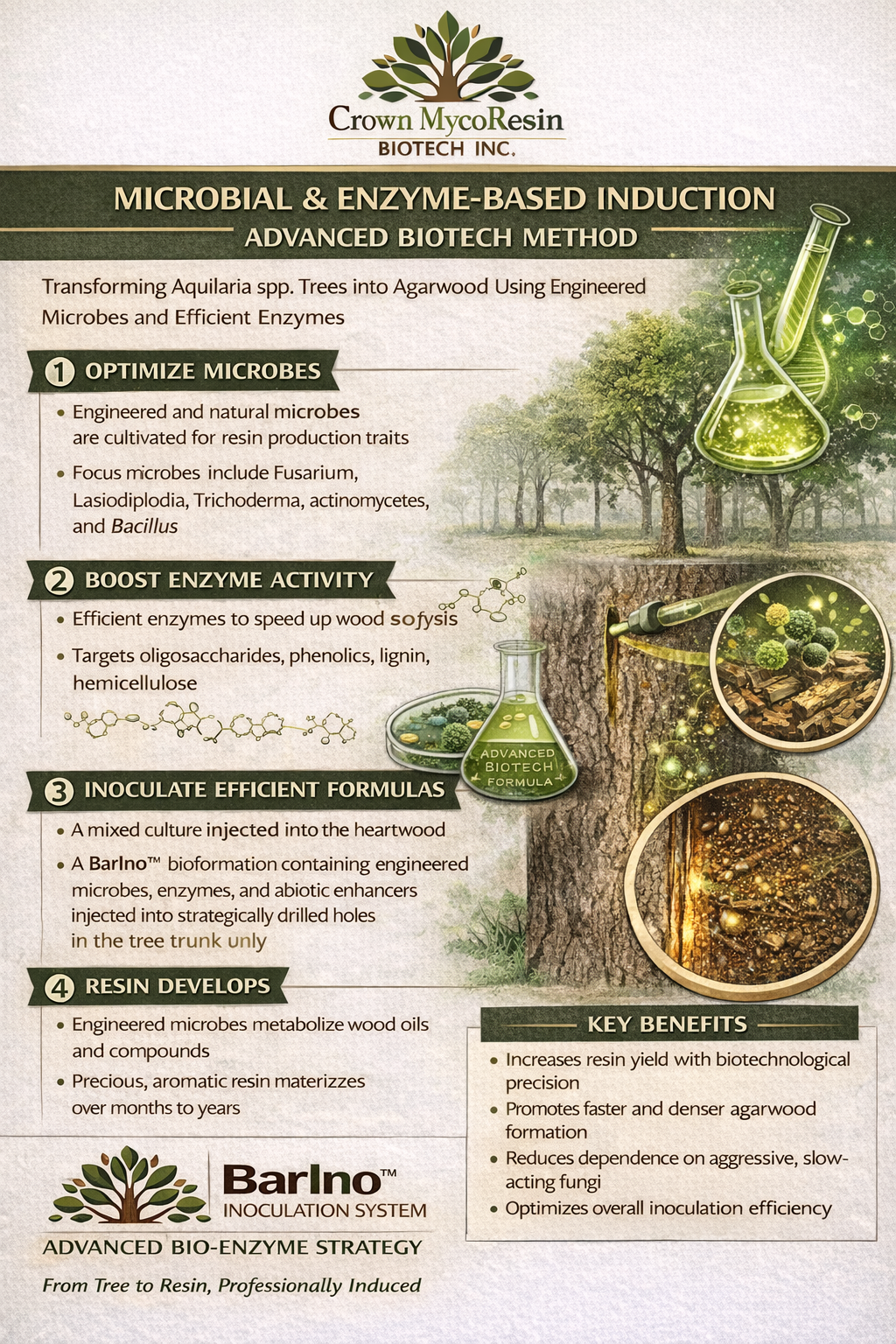
Here’s a detailed, step-by-step Microbial and Enzyme-Based Agarwood Resin Induction Method, written in a way that is scientifically robust, replicable, and suitable for research or plantation application. I’ve structured it to cover preparation, inoculation, monitoring, and evaluation.
1. Objective
To induce high-quality agarwood resin in Aquilaria malaccensis using selected microbial strains and enzymes, in an eco-friendly and sustainable manner.
2. Materials
- 2.1 Biological Materials
- Fungal Strains:
- Fusarium oxysporum
- Trichoderma harzianum
- Aspergillus niger
- Penicillium spp. (optional for comparative trials)
- Enzymes:
- Cellulase (EC 3.2.1.4)
- Ligninase (lignin peroxidase, EC 1.11.1.14)
- Xylanase (EC 3.2.1.8)
- Host Trees:
- Aquilaria malaccensis, age 5–12 years, healthy, disease-free.
- 2.2 Chemicals and Media
- Potato Dextrose Agar/Broth for fungal culture
- Sterile distilled water
- Sodium chloride and buffer solutions (for enzyme stabilization)
2.3 Equipment
- Sterile syringes (10–20 mL)
- Drill or cork borer (2–3 cm diameter)
- Sterile scalpels and forceps
- Parafilm or tree wound sealing materials
- Gloves, masks, and PPE
- GC-MS/HPLC for resin analysis
- Chlorophyll meter and sap flow sensors for tree health monitoring
3. Methodology
3.1 Microbial Culture Preparation
- Obtain pure fungal cultures and maintain on Potato Dextrose Agar at 25–28°C.
- Prepare fungal inoculum in Potato Dextrose Broth, incubate 5–7 days with shaking (120 rpm) to reach ~10⁶–10⁷ spores/mL.
- Quantify spore density using a hemocytometer or plate count method.
3.2 Enzyme Solution Preparation
- Prepare each enzyme solution at 0.5–2% (w/v) in phosphate buffer (pH 6.5–7.0).
- Maintain at 4°C until use.
- Mix enzyme with microbial inoculum immediately before injection for synergistic treatments.
3.3 Tree Selection and Preparation
- Select healthy Aquilaria malaccensis trees, avoiding stressed or diseased individuals.
- Clean the trunk surface using sterile water and remove debris.
- Identify inoculation points 1–1.5 m above the ground, spaced evenly around the trunk.
3.4 Inoculation Procedure
- Drill holes 2–3 cm deep into the xylem at a 45° angle.
- Inject 10–20 mL of microbial or microbial-enzyme inoculum into each hole.
- Seal wounds with sterile parafilm or tree wound paste to prevent contamination.
- Label trees with treatment type and date.
Treatment Groups Example:
| Treatment | Microbe | Enzyme | Notes |
|---|---|---|---|
| T1 | Fusarium oxysporum | Cellulase | Synergistic treatment |
| T2 | Trichoderma harzianum | Ligninase | Synergistic treatment |
| T3 | Aspergillus niger | Xylanase | Synergistic treatment |
| T4 | Fusarium oxysporum | – | Microbe only |
| T5 | – | Cellulase | Enzyme only |
| T6 | – | – | Control (no inoculum) |
3.5 Post-Inoculation Care
- Monitor environmental conditions (temperature, rainfall).
- Water trees as needed to maintain health.
- Inspect wounds biweekly for signs of resin exudation, infection, or contamination.
- Record observations using a resin scoring system (e.g., 0–5 scale based on quantity and color).
3.6 Resin Harvesting
- Harvest resin after 3–12 months, depending on treatment response.
- Collect exuded resin and/or core samples from inoculation site.
- Weigh resin to determine yield per tree.
- Store samples in airtight containers at 4°C prior to chemical analysis.
4. Analytical Evaluation
4.1 Chemical Analysis
- Use GC-MS or HPLC to identify and quantify key sesquiterpenes and 2-(2-phenylethyl)chromones.
- Compare chemical profiles between treatments and control.
4.2 Tree Health Assessment
- Measure leaf chlorophyll content using a SPAD meter.
- Measure sap flow rate to detect physiological stress.
- Monitor wound healing and overall tree vigor.
4.3 Data Analysis
- Perform ANOVA to test differences in resin yield and chemical composition among treatments.
- Apply multivariate analyses (PCA, cluster analysis) for metabolite patterns.
- Evaluate correlation between microbial/enzyme treatment and resin quality metrics.
5. Safety and Sustainability Considerations
- Wear PPE when handling fungi and enzymes.
- Use only non-pathogenic fungal strains.
- Dispose of microbial waste according to biosafety guidelines.
- Maintain tree health to ensure long-term sustainability of plantations.
6. Notes on Optimization
- Enzyme concentration, microbial strain, inoculum volume, and injection depth can be optimized based on preliminary trials.
- Combining multiple microbial strains may enhance resin induction through synergistic effects.
- Monitoring environmental conditions (humidity, rainfall) improves induction success.
This method integrates controlled microbial inoculation with enzymatic enhancement to stimulate natural defense responses, accelerate resin formation, and maintain tree health—a scientifically robust and scalable approach for sustainable agarwood production.